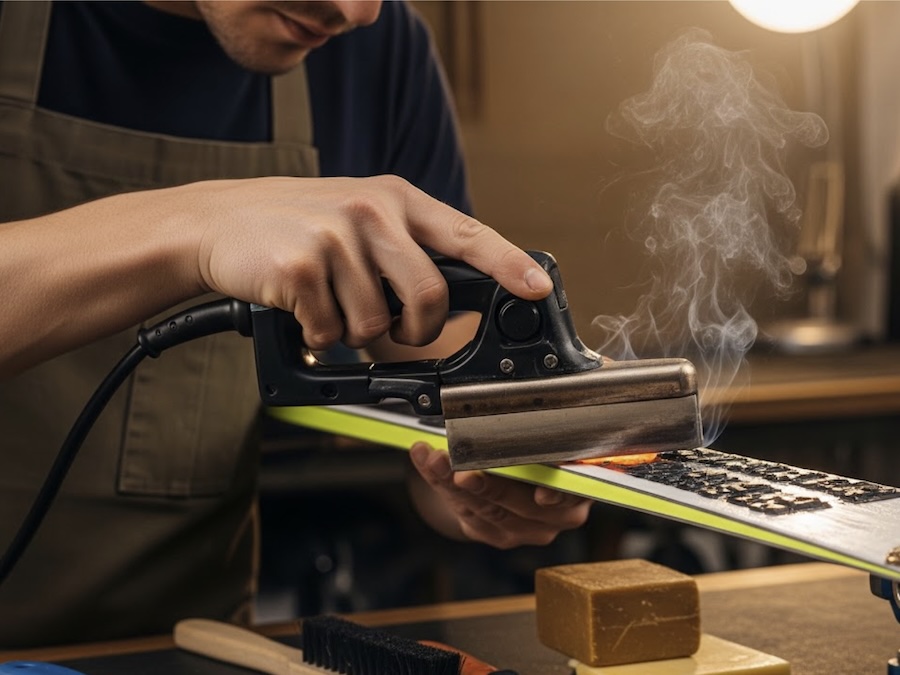
For the past 40 years or so, snowsports competitors have relied on so-called “fluoros” or fluorinated ski waxes. These miracle waxing compounds had a uniquely good ability to shed water and dirt. In turn, that allowed skiers and snowboarders to gain vital fractions of a second on every run. But there was one big elephant in the room–these compounds were made from PFAS forever chemicals! Now we just saw the first Winter Olympics ever where these compounds were banned, with 3 athletes being disqualified as a result.
The history of ski waxing
Waxing skis isn’t new. We have written records from the 1700s of Laplanders using pine resin to create a waterproof and smooth surface on their wooden skis. Over the next centuries, lubrication methods evolved as skiing became more popular and developed into a competitive sport. Early technologies included glycerin, kerosene, and spermaceti (an oily substance found in the heads of sperm whales). By the 1900s we had moved on to paraffin waxes due to their superior waterproof properties. But the biggest technological leap came in the 1980s with the addition of PFAS or per- and polyfluoroalkyl substances.
Why was PFAS perfect for ski waxes?
PFAS compounds were developed in the 1930s. These compounds exhibited an extraordinary ability to shed water, dirt, and grease. They were first used by the US military during World War 2. By the 1950s PFAS were beginning to find widespread commercial applications under brand names like Teflon® and Scotchgard®. These took advantage of the nonstick and dirt repellent properties, respectively, of PFAS compounds. Since then, PFAS have been used in fast food packaging, waterproof clothing, stain repellants, automotive lubricants, and a host of other applications.
Perhaps what is surprising is that it took so long for anyone to try adding PFAS to ski waxes. Whatever the reason, by the mid 1980s, some skiers had started using PFAS based fluorinated ski waxes and found they gave them a distinct edge. Through the 1990s they became mainstream in competitions. By the early 2000s, “fluoros” were truly ubiquitous due to their amazing performance in a wide range of snow conditions. So, what went wrong?
Why are fluorinated ski waxes now banned?
As you may know, there are a couple of major issues with PFAS compounds. Firstly, they are a significant environmental pollutant. Their chemical structure is unusually resilient and they only break down extremely slowly in the environment. In some cases, it can take decades for the compounds to completely break down. This has earned them the nickname “forever chemicals”. Secondly, there has been an increasing body of research linking PFAS with a range of serious health issues. These include cancers, liver and kidney disease, high cholesterol and heart disease, infertility, and reduced immune response.
Worryingly, while ski waxing is a definite niche occupation, research shows that ski waxers have some of the highest rates of PFAS exposure. So it isn’t surprising that in 2023 the FIS (International Ski and Snowboard Federation) banned the use of PFAS waxes in competitive skiing.
Was there any impact on the Olympics?
As the ban on fluorinated ski waxes only came in 3 years ago, Milan-Cortina was the first Olympics where they haven’t been used. It’s hard to quantify the impact on the sport. By its very nature, skiing doesn’t lend itself to classic world records. So we have to rely on anecdotal evidence. This suggests that the latest PFAS-free ski waxes are starting to perform almost as well as “fluoros”. But there have been a lot of teething problems along the way.
Perhaps the biggest impact was the risk of disqualification. Three athletes were disqualified after officials found PFAS in the wax on their skis or snowboards. This shows how seriously the sport is taking the problem of PFAS. We will wait to see how future ski competitions handle the use of PFAS-containing waxes, but for now, the WInter Olympics has shown that they are taking this matter seriously.