

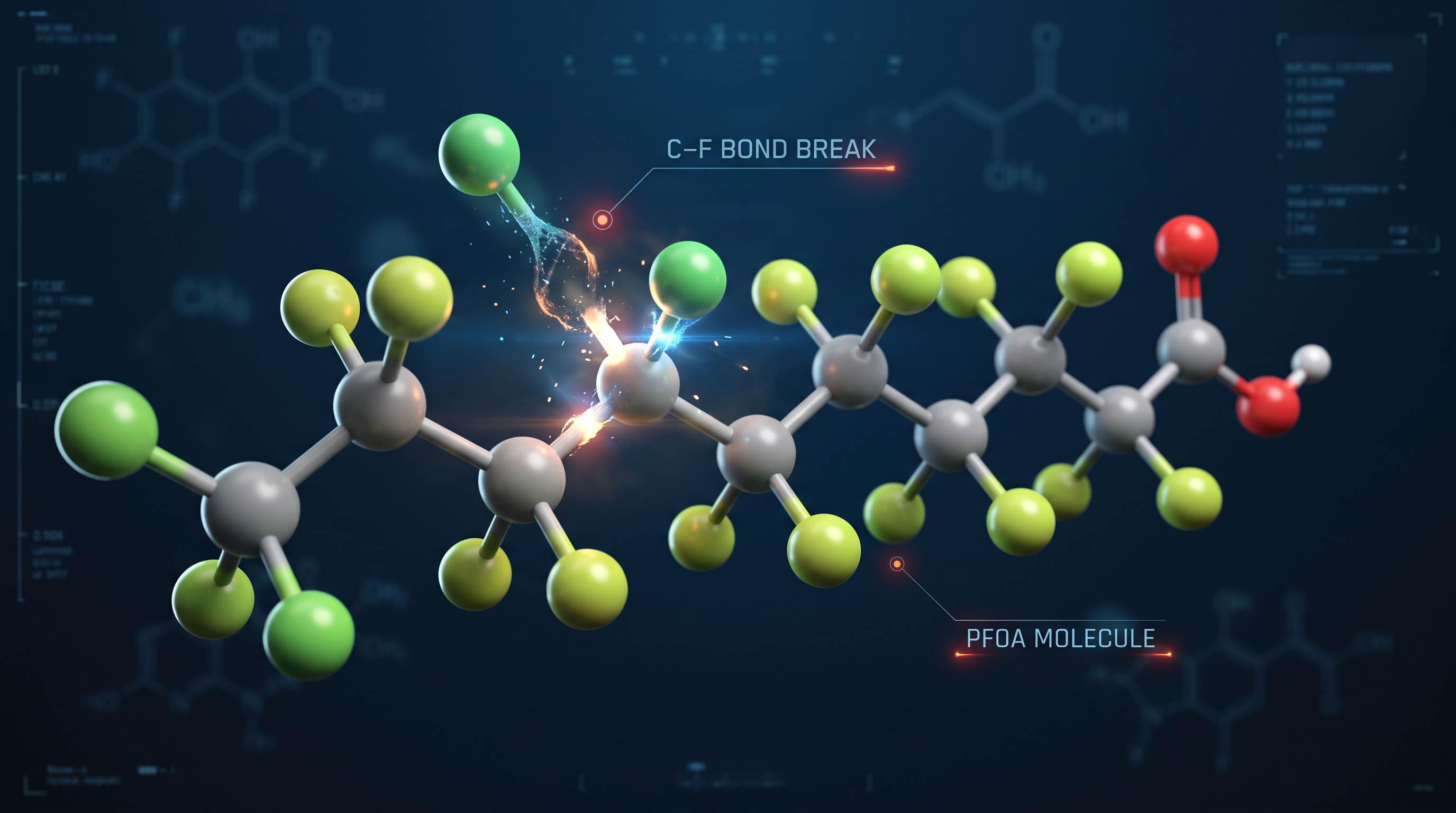
Recent Scientific Breakthroughs Are Finally Destroying "Forever Chemicals"
PFAS "forever chemicals" are arguably the most stubborn pollutants we face today. They are in our drinking water, our non-stick cookware, our waterproof clothing, and unfortunately, in our bodies. At Relentless Health, our mission has always been to help you understand and monitor your toxin exposure, because the long-term health risks, from premature aging and cancer to cardiovascular disease and reduced immune response, are too serious to ignore.
For years, environmental remediation has struggled with a major roadblock: we could filter PFAS out of our water, but we couldn't easily destroy them. All too often, water treatment just meant shifting the toxins from one location to another. The challenge lies in the very nature of PFAS: they are made of carbon-fluorine bonds, which are among the strongest single bonds in organic chemistry. This makes them incredibly useful for industrial applications but a nightmare for environmental cleanup.
But 2026 is proving to be a watershed moment. A tidal wave of new scientific breakthroughs is finally moving us from simply removing PFAS to permanently eradicating them. We are no longer just putting band-aids on the problem; we are developing the tools to cure it.
Advancements in Capturing PFAS
Before you can destroy PFAS, you have to catch them. This has historically been a significant challenge because these chemicals can be incredibly diluted in massive bodies of water.
- The "Nano-Cage" Filters: In 2026, scientists developed innovative "nano-cage" filters capable of hitting a staggering 98% removal rate. These advanced materials are designed to selectively trap PFAS molecules, even at very low concentrations.
- pH Trap-and-Release: Researchers at Florida International University (FIU) unlocked a safer, cheaper, and reusable pH-based method. By manipulating the pH of the water, they can effectively concentrate, trap, and release PFAS from drinking water supplies. This means we can efficiently isolate the contaminants before applying destruction techniques, saving time and resources.
Innovative Destruction Technologies
Once captured, how do we break those famously unbreakable carbon-fluorine bonds? Scientists are attacking the problem from multiple angles, yielding exciting results.
Hydrogen Radicals: Finding the Hidden Weakness
In June 2026, researchers at Aarhus University discovered a massive vulnerability in forever chemicals. By generating hydrogen radicals using intense UV light, scientists can completely break down stubborn PFAS molecules. Crucially, this process does not require adding extra chemicals to the water, paving the way for a greener, more effective destruction mechanism that doesn't create secondary pollution problems.
Extreme Heat and Hydrodynamic Cavitation
A fascinating leap comes from scientists at the Helmholtz-Zentrum Dresden-Rossendorf, who developed a powerful method using "hydrodynamic cavitation."
- Contaminated water is forced through a tight constriction at high pressure.
- This rapid change in pressure creates tiny vapor bubbles in the water.
- When these bubbles violently collapse, they generate extreme, localized heat and highly reactive molecules.
- These forces literally tear the PFAS molecules apart.
Cold Atmospheric Plasma
The same team also pioneered the use of cold atmospheric plasma. By bubbling gas through contaminated water, PFAS (which naturally migrate to surfaces) attach to the rising bubbles. When the bubbles reach the surface, they are blasted apart by the plasma. This method has proven effective at neutralizing both long-chain and short-chain PFAS, offering a versatile solution to the diverse family of forever chemicals.
The Permanent Destruction Imperative
Recent industry reports (such as the developments highlighted in recent tech publications regarding permanent destruction tech for forever chemicals) underscore why these breakthroughs are essential. Traditional disposal methods, like landfills and incineration, are increasingly recognized as inadequate, often just returning the chemicals to the environment in different forms. The push is now firmly toward technologies that achieve mineralization, i.e. the complete breakdown of PFAS into harmless elements like carbon dioxide, water, and fluoride ions. The technologies emerging in 2026 are crucial steps toward making widespread mineralization a reality.
What This Means For Your Health
These breakthroughs are massive wins for public health. Once fully commercialized and scaled, these permanent destruction technologies will allow industries and municipalities to treat contaminated wastewater before it ever reaches our rivers, oceans, or drinking taps. We are finally moving toward a system where we can permanently remove these toxins from the environmental loop.
However, real-world environmental remediation takes time. Scaling these technologies from the lab to global infrastructure will not happen overnight. While science paves the way for a cleaner future, your immediate health remains a priority.
You are exposed to PFAS daily. Prevention, awareness, and monitoring remain your absolute best defenses. By utilizing Relentless Health's science-backed at-home PFAS blood tests, you can:
- Monitor your current PFAS levels.
- Track how your levels change over time based on lifestyle adjustments.
- Take control of your well-being with personalized, data-driven insights.
The future of PFAS destruction is bright, but until these technologies finish cleaning up our world, Relentless Health is here to help you protect yourself today.
Disclaimer: This article is for educational and informational purposes only. Nothing in this article or on the web site represents medical advice or an offer of medical, diagnostic, or treatment products or services. Anyone concerned about their health should consult a licensed medical professional.
